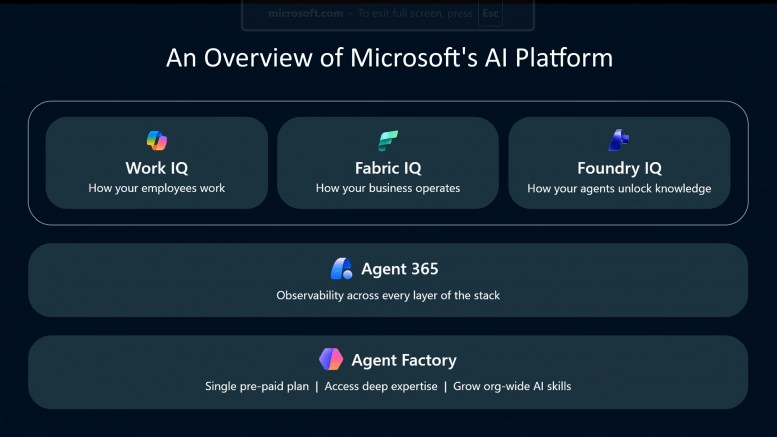
Microsoft’s AI platform isn’t just about models or copilots; it’s about building intelligent, trustworthy, and governable AI agents that can operate safely at enterprise scale.
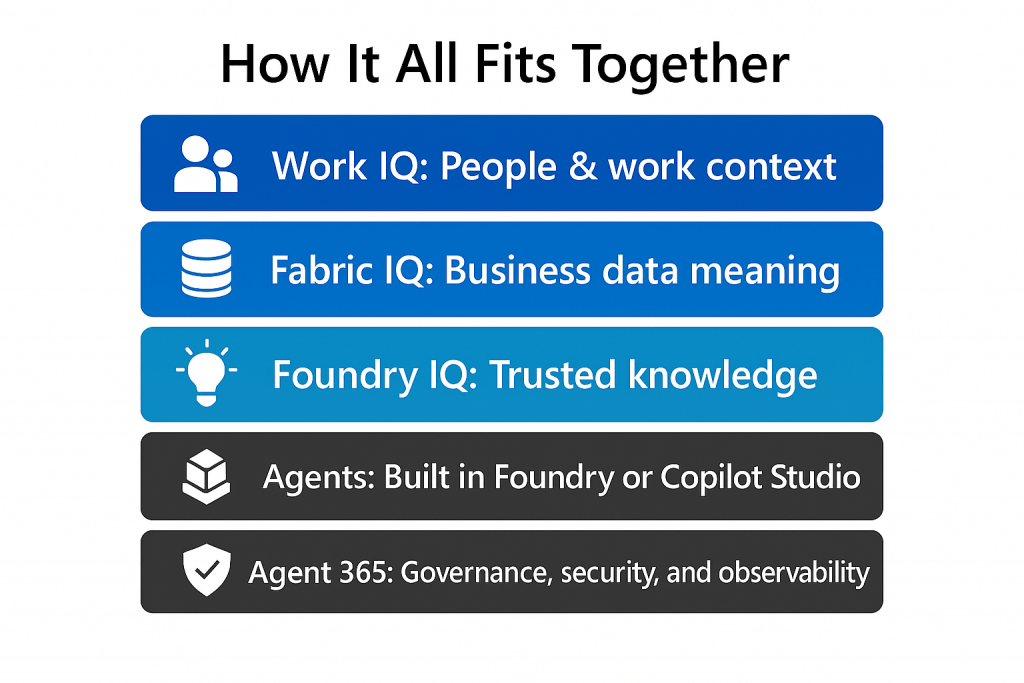
At the core of this strategy are three IQ layers (Work IQ, Fabric IQ, and Foundry IQ), two agent platforms (Agent Foundry and Copilot Studio), and one governance plane (Agent 365). Together, they form a clean, intentional architecture for agentic AI.
Why Microsoft Split AI Into “IQ” Layers
Traditional AI answers questions, Agentic AI supports decisions and takes action. To perform this safely, agents need:
- Context about people and work
- Understanding of business data
- Access to trusted, governed knowledge
- A way to be built, run, and controlled
That’s exactly what Microsoft’s AI platform delivers. This architectural separation is intentional and critical for scalable, autonomous AI.
Work IQ: Understanding How Work Happens
Work IQ lives in Microsoft 365 and provides context about how people actually work from:
- Emails, meetings, chats (Teams)
- Documents and collaboration patterns
- Organizational and relationship signals
- Personal and teamwork habits
Why it matters: Without Work IQ, AI treats documents as isolated files. With it, Copilot and agents understand why something matters, who is involved, and what comes next. Find out more: Work IQ.
Fabric IQ: Understanding What Data Means to the Business
Fabric IQ lives in Microsoft Fabric and gives AI semantic understanding of enterprise data.
- Applies business meaning to data (customer, revenue, margin, risk)
- Uses Power BI semantic models as first‑class intelligence assets
- Enables reasoning across time, geography, and relationships
- Bridges operational and analytical data
Why it matters: AI without Fabric IQ can read numbers but not explain their impact. Fabric IQ turns metrics into business insight, enabling agents to recommend actions; not just report facts. Find out more about Fabric IQ.
Foundry IQ: Understanding how trusted knowledge is unlocked
Foundry IQ lives in Microsoft (Azure AI) Foundry and provides the trust layer for AI. It enables:
- Agentic retrieval across policies, contracts, procedures, and knowledge bases
- Permission‑aware, auditable answers
- Multi‑source reasoning (not simple RAG)
- Citations and traceability
Why it matters: Without Foundry IQ, AI can hallucinate or violate policy. With it, agents return official, secure, and defensible answers. Find out more about Foundry IQ.
Agent Foundry & Copilot Studio: Where Agents Are Built
Once intelligence exists, agents need a runtime.
Microsoft Foundry (Agent Foundry)
- Pro‑code agent platform
- Model selection and routing
- Tool orchestration and multi‑agent workflows
- Observability and secure execution
- Native integration with all IQ layers
Copilot Studio
- Low‑code / declarative agent creation
- Business‑led scenarios
- Deploy agents into Microsoft 365 Copilot, Teams, web, and apps
Find out more about the Foundry Agent Service.
Agent 365: Governing Agents at Enterprise Scale
Agent 365, introduced at Microsoft Ignite 2025, is the control plane for AI agents.
- Central agent registry and identity
- Access control and risk policies
- Security monitoring and telemetry
- Governance across Copilot, Foundry, and third‑party agents
Find out more about Microsoft Agent 365.
Why This Matters for SQL Server & Fabric Professionals:
- Semantic models become intelligence, not just business artifacts
- Fabric IQ elevates Power BI models into decision‑making engines
- Agent governance becomes as important as data governance
- SQL Server and Fabric now directly influence AI reasoning and actions
- This is a fundamental shift from reporting data to powering decisions.
Final Takeaway
Microsoft isn’t just adding AI features: it’s building a full-stack intelligence and agent platform. If you’re designing modern data or AI architecture, Work IQ, Fabric IQ, Foundry IQ, Agent Foundry, and Agent 365 aren’t just designing concepts; they’re the foundation.
Be the first to comment on "An Overview of Microsoft’s AI Platform"