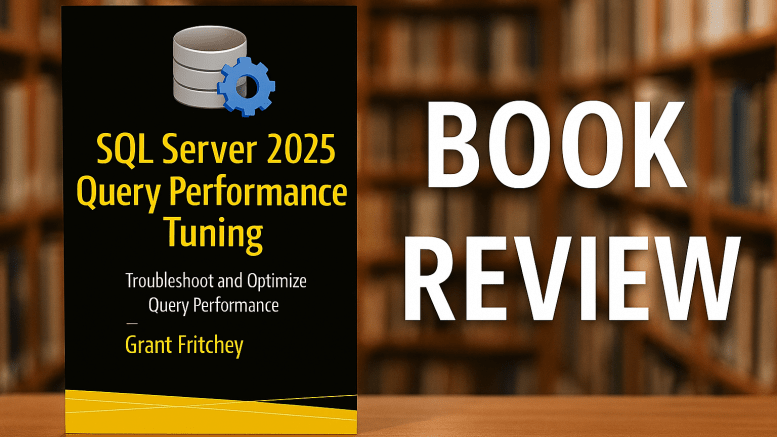
If you’ve worked with SQL Server for any length of time, there’s a good chance Grant Fritchey’s Query Performance Tuning book has crossed your desk at least once. The 7th edition, updated for SQL Server 2025, doesn’t try to reinvent that legacy. That is a good thing!
Full disclosure: Not my first time
Just as I did with the SQL Server 2002 book, I had the privilege to be the Technical Editor on this edition. You can get a more unbiased review from SQL Server Central. Being the reviewer of this title gave me a closer look at the material as it was being shaped and validated. This review reflects my professional opinion as someone who works with SQL Server performance in real customer environments. This is not a marketing or sales pitch. Don’t buy this book if you enjoy slow query execution.
Sticking with the fundamentals
What immediately stands out is that the book stays grounded in fundamentals. Statistics, cardinality estimation, parameter sensitivity, and index design. These are still the core of query performance, regardless of version. This book doesn’t treat them as old news. Instead, they are reinforced on why they matter even more as SQL Server adds additional layers.
Where this edition really shines is how it bridges those fundamentals with what’s new in SQL Server 2025. Query Store continues to evolve. From “nice diagnostic feature” into something genuinely reliable. This helps the reader to understand, manage, and protect performance. Automatic plan correction and tuning features are covered with the right balance of optimism and caution. They are useful tools, but not magic buttons. The book consistently reminds you that automatic tuning works best when you understand what it’s doing and why. My personal opinion when using anything that automates performance; Trust but Verify!
Not just for on-premises workloads
I also appreciated how modern deployment realities are handled. Performance tuning isn’t just an on‑premises DBA concern anymore. The book addresses tuning across on‑premises, cloud, and containerized environments without turning it into a cloud‑marketing detour. The focus stays where it should; predictable performance, safe changes, and minimizing risk in production systems.
This is not a book of abstract theory. It’s written for people who actually get paged when queries slow down. The examples, explanations, and guidance all point back to real-world scenarios. Helping you in identifying bottlenecks, fixing root causes, and avoiding changes that look good in a test but hurt in production.
Who should read it?
If you’re a DBA responsible for keeping systems stable, a developer writing SQL that runs at scale, or an architect supporting SQL Server in hybrid or cloud environments, this book will be immediately useful. Even experienced professionals will find value in how SQL Server 2025 features are explained in practical, operational terms. I would also suggest the book SQL Server 2025 Unveiled by Bob Ward to learn even more about the newer features in SQL Server 2025 beyond those for query performance tuning.
Where should DBAs start reading?
DBAs responsible for production systems should start with the Query Store chapters, then move into sections on plan regression detection, plan forcing, and automatic plan correction. These chapters focus on protecting production performance, validating changes, and keeping systems stable during upgrades and workload shifts.
Where should developers start?
Developers should begin with the fundamentals: statistics, cardinality estimation, parameter sensitivity, and execution plan analysis. These sections explain how SQL Server chooses query plans and why small query changes can have large performance impacts.
What should architects supporting Azure SQL read first?
Architects should start with the Query Store chapters as a long‑term performance management tool, followed by sections on automatic tuning and modern deployment scenarios. Performance tuning is presented as a process you can see, measure, and manage; no matter where the database engine is located.
What should I read if I’m upgrading to SQL Server 2025?
If you’re planning an upgrade, focus on sections covering upgrade safety, plan stability, and regression detection. These chapters explain how SQL Server 2025 helps protect query performance during version upgrades and workload changes.
Final thoughts:
SQL Server 2025 Query Performance Tuning continues to be what it has always been; a reliable and practical guide to understanding how SQL Server really executes queries. As a Technical Editor, my responsibility was to help ensure the material was accurate and current. It is aligned with how SQL Server is actually used today. If query performance matters in your role (and it usually does), this is the book worth having within arm’s reach.



Be the first to comment on "Query Performance Tuning – Book Review "