At both FABCON and SQLCON 2026, a clear and deliberate message for SQL Server professionals was delivered; SQL Server is not being replaced, it is being elevated. Across the keynote address, community blogs, and technical demos, the announcements outlined how SQL Server, Azure SQL, and Microsoft Fabric are converging into a unified, AI‑ready data platform, without abandoning existing investments or forcing architectural pivots.
For those running mission‑critical SQL Server workloads today, the announcements focused less on hype and more on practical modernization, hybrid continuity, and AI‑enabled evolution.
A Converged SQL Platform is Not a Fabric Takeover
One key takeaway was the framing of SQL Server, Azure SQL, and SQL in Fabric as a single, consistent SQL engine. Solutions that span on‑premises, PaaS, and SaaS environments. Fabric is an extension and unification layer, not a replacement. Thus, bringing operational, analytical, and AI workloads closer together.
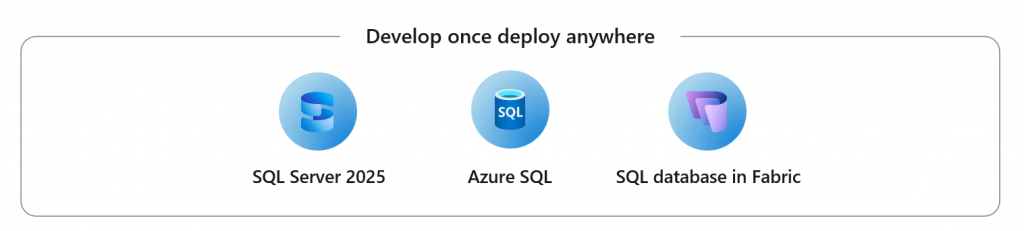
This isn’t a big shake‑up, it’s about how things fit together. SQL Server keeps running where it already makes sense, whether that’s on‑premises, in virtual machines, or through Azure Arc. At the same time, Azure SQL and Fabric plug into a shared way of managing, securing, and analyzing data. The key point is that hybrid SQL isn’t a stopgap, it’s a real, long‑term approach.
SQL Server 2025 as the Foundation for AI‑Ready Workloads
SQL Server 2025 consistently appeared as the foundational release for modern SQL development. The conference highlighted the strong adoption trajectory of SQL Server 2025. This highlighted that recent innovations support AI‑driven applications while preserving core relational database principles. Here is a guide on setting up your own SQL Server 2025 Practice Environment.
Technical demos showcased capabilities that are directly relevant to enterprise customers, including:
- Native vector data support
- Improved JSON handling
- Modern string and comparison functions
- Query optimizer enhancements aimed at mixed transactional and analytical workloads
The message is clear: SQL Server remains a system of record and now serves as a system of intelligence.
SQL + AI: From Concept to Built‑In Capability
AI embeds directly into SQL workflows instead of relying on external services bolted onto databases. Using SQL Server 2025, Azure SQL, and SQL databases in Fabric, sessions walked through real implementations. Including vector search, retrieval‑augmented generation (RAG), and agent‑driven query orchestration, all using SQL as the core data engine. Here is a Guide on setting Up Ollama for SQL Server.
A key emphasis was on noting that nothing changes when it comes to security. The same protections you already use, like row‑level security, still apply, even when AI is accessing your data. That means you can try out AI features without exposing data or putting compliance and governance at risk.
Azure SQL is part of the Fabric Story
Azure SQL showed up as a first‑class part of the Fabric story, not something on the side. The conversation highlighted Azure SQL working alongside Fabric analytics and AI to deliver near‑real‑time insights on operational data.
For people already using Azure SQL Database or Managed Instance, this is good news. You don’t need to move platforms or rethink your architecture to modernize. Your existing Azure SQL deployments can plug straight into Fabric and take advantage of analytics and AI without starting over.
Introducing the Database Hub in Microsoft Fabric
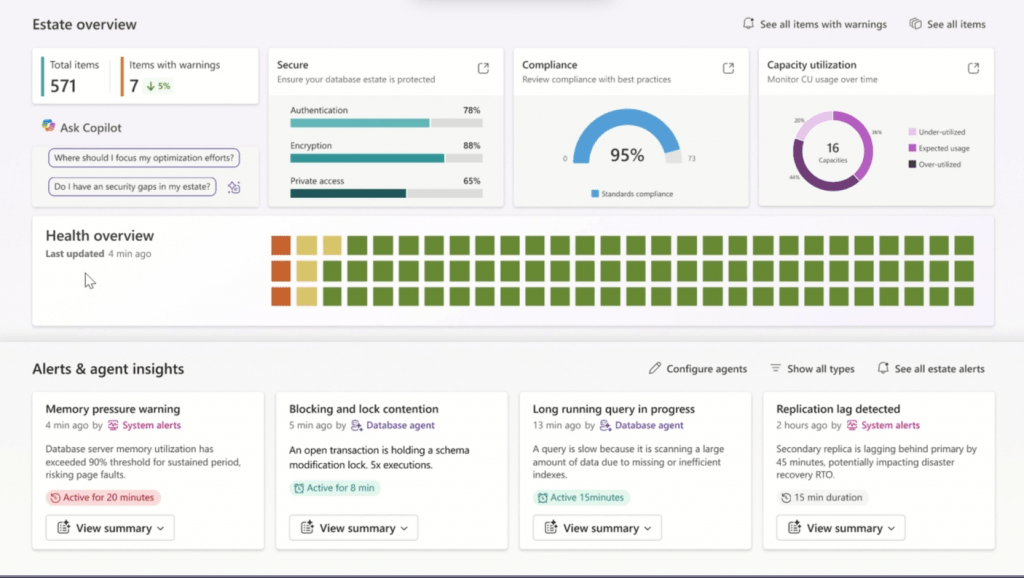
A significant platform announcement was the Database Hub in Microsoft Fabric, currently available in early access. The Database Hub makes life easier when you’re managing lots of different databases. It brings things like Azure SQL, SQL Server (through Azure Arc), and other Azure databases into one place. It doesn’t replace existing tools; it centralizes them with database monitoring, governance, and optimization across all environments. For large, distributed SQL platform estates, it simplifies operations and improves visibility without forcing consolidation onto one platform.
What They Did Not Announce and Why That Matters
What SQL Server administrators should note just as much is what the announcement did not include:
- No SQL Server deprecations
- No licensing changes
- No mandatory Fabric migrations
- No “Fabric‑only” roadmap language
The absence of disruptive announcements reinforces the event’s broader theme: continuity with evolution. The SQL Server strategy is additive, not subtractive, and deliberately designed to respect long‑lived enterprise architectures. FABCON and SQLCON 2026 delivered a reassuring message:
- SQL Server remains strategic and actively innovated
- The platform explicitly supports hybrid and on‑premises SQL environments.
- SQL includes AI enablement directly, rather than adding it as a separate layer.
- Fabric enhances SQL estates without replacing them
The next phase of SQL modernization, the path forward is not about abandoning SQL Server; it’s about extending it intelligently.
References:
- FabCon and SQLCon 2026: Unifying databases and Fabric on a single data platform
- Advancing Databases for the Next Generation of Applications
- Early Access for Database Hub in Microsoft Fabric
- FABCON 26 – Microsoft Fabric Community Conference – FABCON
- SQLCON – Microsoft SQL Community Conference – SQLCON
- Sample demos used a Fabric & SQL Conference 2026 · GitHub
- Azure SQL Samples Search with AI
- SQL Server 2025 Practice Environment Guide
- Guide for Setting Up Ollama for SQL Server
Be the first to comment on "SQL Server at FABCON & SQLCON 2026"