AI in the data platform is evolving fast, but what’s often missing in conversations is context. Not just data, but how work happens, what data means, and where knowledge lives.
That’s where Microsoft IQ comes in.
Rather than a product, Microsoft IQ represents a three-layer intelligence framework, Work IQ, Fabric IQ, and Foundry IQ, designed to make AI agents and Copilot experiences context-aware, governed, and enterprise; ready.
For SQL Server DBAs, this isn’t just “another AI announcement.” It’s a shift in how:
- Data is interpreted (not just stored)
- Queries are generated (not just written)
- Insights are delivered (not just reported)
The Big Picture: Microsoft IQ Architecture
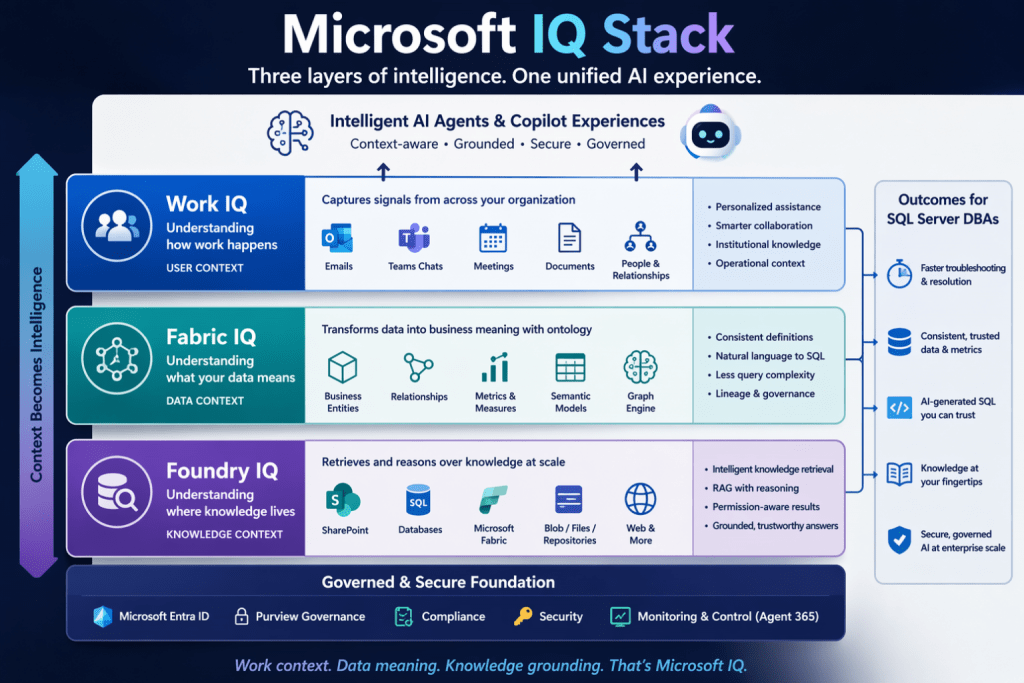
These layers are not standalone services; they are architectural capabilities that together enable AI agents to operate with real enterprise understanding.
Work IQ: Understanding How Work Happens
Work IQ is the intelligence layer that models how people work, based on signals from:
- Emails
- Teams
- Meetings
- Documents
- Collaboration patterns
It powers Microsoft 365 Copilot by adding user-specific context, memory, and inference.
Key Concepts
- Data layer: Access to Microsoft 365 + business systems
- Memory layer: Learns patterns, habits, and relationships
- Inference layer: Connects signals to suggest actions
This allows AI agents to predict intent and recommend next steps, not just respond to prompts.
Why SQL Server DBAs Should Care
Work IQ impacts DBAs indirectly; but significantly:
1. Smarter Operational Assistance
- Copilot can correlate incidents with past tickets, emails, or war rooms
- Reduced time to resolution for outages or performance issues
2. Context; Aware Automation
- Automate runbooks based on team behaviors
- Surface relevant scripts or queries based on prior usage patterns
3. Collaboration Intelligence
- Identify who owns a workload, database, or report
- Reduce tribal knowledge gaps
Think of Work IQ as the DBA’s “institutional memory engine”.
Fabric IQ: Turning Data into Meaning
Fabric IQ introduces a semantic intelligence layer on top of your data estate. Instead of working with tables and columns, Fabric IQ enables:
- Business entities (Customer, Order, Product)
- Relationships between entities
- Metrics and domain logic
This is achieved through a model driven by structured relationships and defined concepts.
Core Capabilities
- Ontology: Defines entities, properties, relationships
- Graph engine: Enables multi; hop reasoning across data
- Semantic models: Extend Power BI logic into AI
- Agents: Query and act on business meaning
Fabric IQ effectively transforms Fabric from a data platform into an intelligence platform.
Why SQL Server DBAs Should Care
This is where things get very real for DBAs.
1. From Tables to Business Concepts
- Instead of writing:
- SELECT SUM(SalesAmount) FROM FactSales WHERE Region = ‘West’
- AI can understand:
- “What were last quarter’s sales in the West region?”
2. Elimination of Semantic Drift
Different teams could be defining “Customer” differently. Fabric IQ resolves this by creating a shared enterprise vocabulary, ensuring consistency across:
- SQL databases
- Synapse / Fabric warehouse
- Power BI reports
- AI agents
3. Reduced Query Complexity
Ontology allows querying concepts instead of joins:
- No need to manually stitch tables
- Relationships are already defined
- AI generates correct queries automatically
4. Better Governance and Lineage
Fabric IQ links data definitions, business meaning, and data lineage that improves compliance, auditing, and trust in AI-generated insights. Think of Fabric IQ as the semantic layer DBAs always wanted; but never had at scale.
Foundry IQ: The Knowledge Layer for AI
Foundry IQ addresses the hardest problem in enterprise AI… “How does the system find the right knowledge?” The answer: It builds on Retrieval Augmented Generation (RAG) and evolves it into Agentic RAG:
- Multi-step query decomposition
- Multi-source retrieval
- Reasoning across knowledge bases
Key Capabilities
Unified knowledge access across:
- SharePoint
- Databases
- Fabric
- Blob storage
- Permission; aware retrieval
- Iterative search and reasoning
- Knowledge grounding for AI responses
Why SQL Server DBAs Should Care
1. Query + Documentation Fusion
Imagine asking: “Why did this query slow down last week?”. Foundry IQ can pull from these sources and synthesize a grounded answer.
- Query Store data
- Runbooks
- Incident reports
- Documentation
2. Eliminating “Where Is That Script?”
Foundry IQ connects everything into a single knowledge layer, so no more hunting for:
- Stored procedures in old repos
- Runbooks in SharePoint
- Notes in Teams
3. Secure Knowledge Retrieval
All retrieval is permission-aware and governed through Entra ID and Purview. Thus, eliminating accidental data exposure while maintaining enterprise-grade compliance. Think of Foundry IQ as enterprise search for your data and documentation, now enhanced with built-in reasoning.
How It All Comes Together (For DBAs)
| Layer | Purpose | Context Type |
| Work IQ | Who is doing the work? | User context |
| Fabric IQ | What does the data mean? | Data context |
| Foundry IQ | Where does the knowledge live? | Knowledge context |
Together, they enable:
- AI-generated, SQL grounded in business meaning
- Automated troubleshooting with real context
- Consistent metrics across reports and queries
- Knowledge; driven DBA workflows
Final Thoughts: The Future DBA Experience
| Traditional DBA Work | Future with IQ |
| Write queries | Validate AI-generated queries |
| Manage schemas | Define semantic models |
| Document processes | Feed knowledge systems |
| Respond to issues | Collaborate with AI agents |
This doesn’t replace DBAs; it augments them with intelligence layers that reduce friction and accelerate decision-making.
References & Further Learning
- Microsoft IQ Overview (Work IQ, Foundry IQ, Fabric IQ)
- Work IQ, Fabric IQ & Foundry IQ | Marquee Insights
- Introducing Microsoft Work IQ: The Intelligence Layer
- What Is Fabric IQ? Ontology Explained
- Microsoft Fabric IQ Ontology Docs
- Foundry IQ: the future of RAG with knowledge retrieval and AI Search
- Microsoft Agent 365 creation, Work IQ and control plane explained
- Explaining Microsoft Work IQ, Agent Types


Be the first to comment on "Microsoft IQ for the SQL Server DBA"